
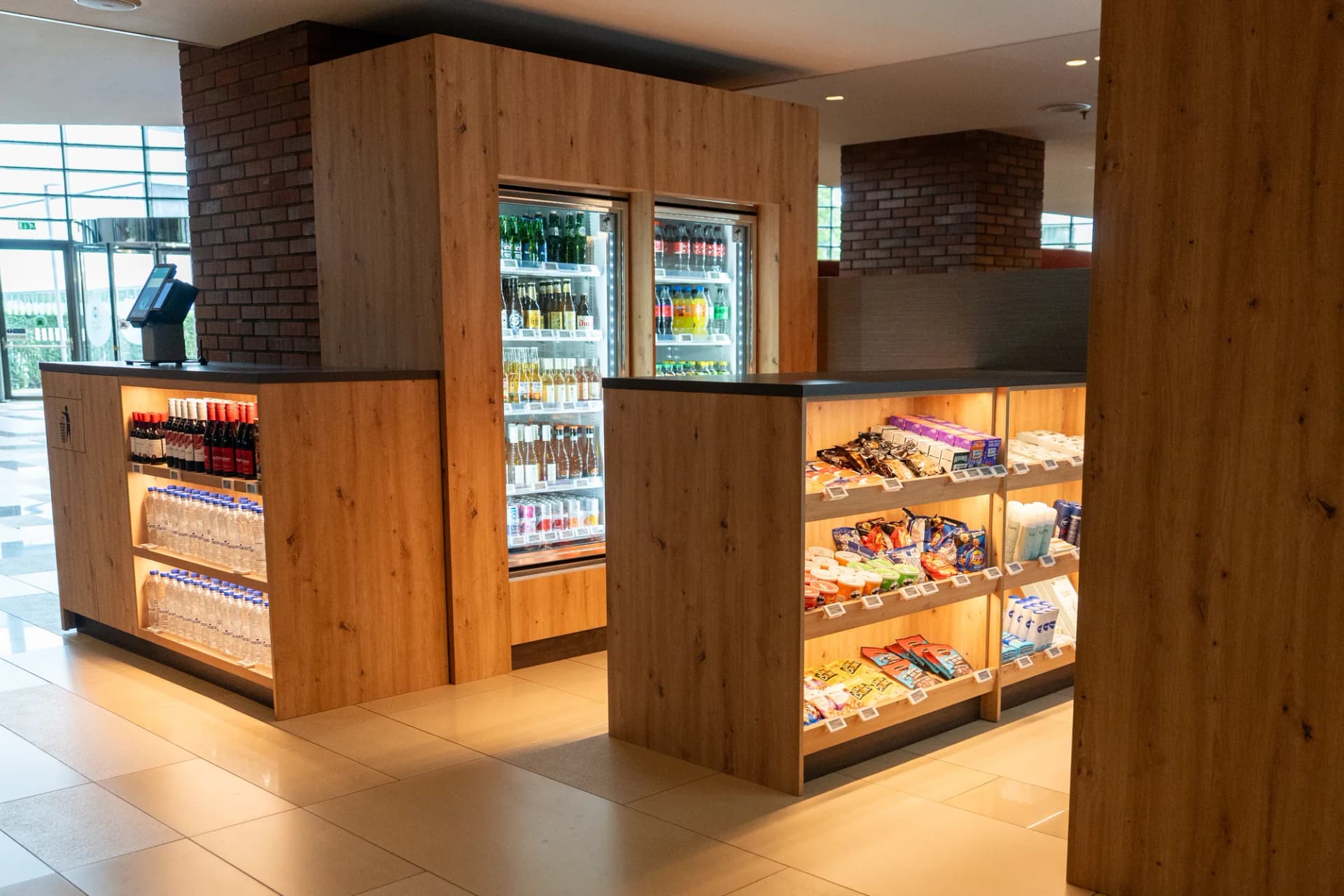
A minibar gives guests access to drinks in their room. For the hotel, it also brings stock checks, replenishment, refrigeration and billing. Whether replacing it makes sense depends on the actual workload and the service your guests have been promised. A central Lobby Market can be an alternative when you want to bring these tasks together and offer a broader range in one place, around the clock.
What does a minibar cost to operate?
Choose a representative period and keep room categories with different offers separate. Compare the products sold with the full cost of providing them. A high selling price alone tells you little about what remains after operating costs. Use your own hotel data to establish where the time and money go before deciding what to change.
Housekeeping checks and replenishment
Record the time spent checking stock, refilling units, walking to storage and reporting consumption. A check that finds no sales still takes staff time. Multiply the measured hours by your actual staffing costs. Then assess which tasks a central shop would remove and which responsibilities your team would still need to carry out.
Stock costs, expiry dates and billing
Alongside the purchase cost of products sold, include expired stock, missing items and goodwill refunds. Note how often reception deals with disputed minibar charges. This helps you distinguish between a problem with the range, a recording issue and a wider problem with the operating model. Each may call for a different response.
Energy, maintenance and replacement equipment
Use measured consumption or the specifications for your equipment, together with your actual electricity tariff. Include cleaning, repairs and upcoming replacements. A Lobby Market also needs refrigeration and power. Any potential saving therefore depends on the specific equipment and operating hours being compared. Simply counting the number of fridges does not give you the full picture.
How does a Lobby Market work as a minibar alternative?
A Lobby Market is a central self-service shop within the hotel. Guests choose drinks, snacks and, depending on the agreed range, fresh food or travel essentials, then pay through the shop’s payment system. It is designed for round-the-clock availability, including when the bar or restaurant is closed. Replenishment and stock management are brought together in one location.
The guest journey changes: instead of taking a product from the minibar, guests visit the lobby. In return, the shop can offer more choice. Make prices visible, instructions clear and the location easy to reach. Match the range to your guests and the opening hours of your existing food and beverage services.
Replace every minibar or keep them in selected rooms?
A complete change is worth considering where minibars require substantial work, see limited use and the lobby is accessible to guests. If in-room refreshments are part of the booked service, adding a hotel shop alongside the minibar may be more suitable. Make this decision by room category rather than treating every room as identical.
- Standard rooms: consider a phased replacement where usage and operating costs support the decision.
- Suites and higher room categories: retain minibars where they form part of the comfort guests expect or have booked.
- Rooms with an empty fridge: storage for guests’ own drinks can remain a separate amenity. Cleaning and energy costs also remain.
- Guests with reduced mobility: plan suitable assistance where reaching the shop independently may be difficult.
Who handles replenishment, maintenance and support?
Selecta takes full responsibility for running the shop: replenishment, daily quality and expiry checks, cleaning and maintenance are standard services. Its own staff visit every day, seven days a week, and more often when needed. Selecta schedules these visits itself, independently of product suppliers’ delivery or visit schedules, to keep shelves stocked.
Your hotel does not need to hire shop staff or organize replenishment, daily shop checks, cleaning and maintenance. Reception can direct guests to the shop and pass questions or faults to Selecta. A hotel contact discusses preferences and exceptional situations; Selecta runs the daily shop operation.
Compare the contribution of minibars and a central hotel shop
Compare current minibar income after purchasing and your own operating costs with the revenue share your hotel receives from Selecta. Selecta bears the standard shop operating costs. Consider space, electricity and any own-capital contribution separately. A transferred minibar purchase is not new demand; out-of-hours purchases, grab-and-go and travel essentials can bring additional spending.
Assess financing and the hotel’s percentage separately with the guide to shop turnover, hotel income and financing.
The hotel revenue calculator on this website provides an initial, indicative estimate based on room count, occupancy and location. Use it as a starting point for a conversation. The actual revenue share and agreed services belong in the detailed proposal.
For the equipment choice in the lobby, see the comparison of lobby shops, vending machines and smart fridges.
Checklist: plan the changeover in stages
- Establish a baseline: record minibar use, costs and guest feedback for each room category.
- Define the offer: decide which minibars to retain and which guest needs the Lobby Market should cover.
- Check the location: agree available space, accessibility, power supply and the connections required for the chosen equipment.
- Record the revenue share, included daily Selecta service, space and electricity, and any own-capital contribution.
- Prepare for opening: brief reception and housekeeping, test the purchase process and update room descriptions and guest information.
- Change over gradually: open the shop before withdrawing the relevant minibars. Then review usage, feedback and the actual workload.
The planning and installation process described on this website uses around eight weeks as a guide. Agree the schedule for your hotel after assessing the space, equipment and preparatory work. Rooms can then be changed over by category or floor.
Frequently asked questions about replacing hotel minibars
Is a Lobby Market the better option for every hotel?
It depends on minibar use, operating costs, guest needs and access to the lobby. Where in-room refreshments are part of the promised service, a Lobby Market can complement the minibar. Assess the decision for each room category.
Do all minibars need to be removed at once?
No. You can open the shop first and change over in stages. Minibars in suites or higher room categories can remain alongside it. Update the descriptions of affected rooms and inform your guests.
Which housekeeping tasks are removed?
Rooms without a stocked minibar no longer need its stock checks or replenishment. Measure the time saved in your own hotel. If an empty fridge remains, its cleaning and maintenance still need to be planned.
Who replenishes the Lobby Market?
Selecta provides this as standard through its own staff, every day, seven days a week, and more often when needed. Replenishment, daily checks, cleaning and maintenance are included in the fully managed Lobby Market. The hotel does not need to carry out these shop duties.
Does the hotel face costs when switching?
No own capital is required for a Lobby Market. Selecta can develop flexible financing tailored to your hotel or hotel group. An own-capital contribution creates scope for more attractive terms, such as a higher revenue share and/or shorter contract duration. Selecta bears the cost of this standard shop operation within the revenue-share model. The hotel receives an agreed percentage of sales, with no separate bill for routine replenishment, daily checks, shop cleaning and maintenance. You provide the space and electricity. Any building works or own-capital contribution are discussed separately.
How long does the changeover take?
This website gives around eight weeks as a guide for planning and installation. The specific schedule depends on equipment, location and preparatory work and is agreed individually. Minibars can then be phased out by room category or floor.