
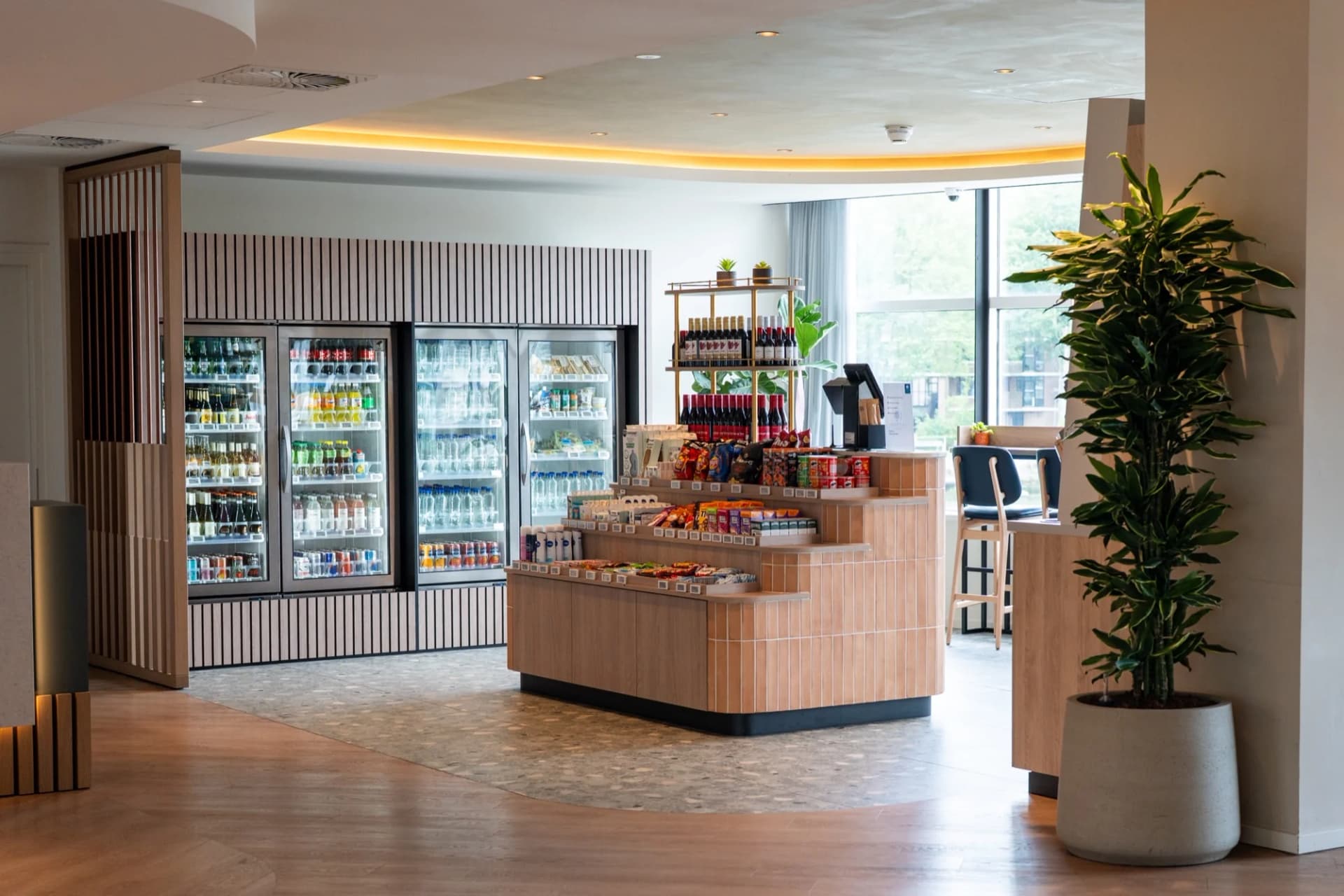
What is a hotel micro market?
A hotel micro market is a self-service shop where guests choose products and pay for them themselves. It typically combines shelves, chilled products and a checkout in or near the lobby. The shop can remain accessible around the clock, including when the hotel bar or kitchen is closed. There is no shop assistant behind a counter, but daily care of the shop remains essential.
Hoteliers also use terms such as lobby shop, hotel convenience store and mini market. Micro market describes the retail concept; grab and go describes how guests use it: quickly picking up something for their room, their journey or checkout. Whatever the name, the practical question is the same: what do your guests want to buy, when and with how much convenience?
Which retail format suits the lobby?
An open hotel shop with shelves and fridges
In an open lobby shop, guests browse the range, combine products and check out themselves. The design can reflect the hotel’s identity. When choosing its position, consider visibility on arrival, room to browse and a clear payment step. A large shop away from the guest route is not automatically better than a compact shop in a convenient position.
A compact smart fridge or chilled module
A smart fridge may suit a focused chilled selection better than a full store. Access and payment depend on the technology selected. Compare the steps guests take, the space for products and the daily service. A smart fridge and an open mini market do not automatically provide the same shopping experience.
Vending or a combination of modules
A vending machine can suit a defined product selection. Modern vending can also offer contactless payment and chilled or fresh products, so these are not exclusive advantages of a micro market. The decision concerns range, presentation and use. Read the comparison of lobby shops, vending and smart fridges for the differences in each situation.
Which hotels and guest occasions suit a mini market?
- An airport or station hotel: late arrivals, early departures and something for the journey.
- A business hotel: a quick purchase between meetings or after a long working day.
- A city hotel: convenience on returning, a forgotten travel essential or a purchase without going outside.
- A hotel with a restaurant or bar: availability outside opening hours and for guests who do not want a full meal or table service.
These are use cases, not a guarantee of a profitable shop. Consider occupancy, guests per room, length of stay, walking routes and the existing offer in and around the hotel. Room count alone does not tell you how many guests will buy something. The hotel’s service promise matters too: personal service may remain central to a luxury stay.
To compare proposals, use the guide to choosing an unmanned hotel shop to assess the format, service and commercial terms against your hotel’s needs.
The range: beyond snacks and drinks
Start with needs during the stay. Guests may want something to use immediately, take to their room or carry on their journey. Alongside food and drinks, toothbrushes, toothpaste, personal care items, condoms and chargers or cables can be useful additions. This gives the hotel shop the role of a small convenience store. The actual range is tailored to your guests; every shop need not carry every product.
Selecta adjusts the selection using sales and guest needs. An item that often runs short or rarely sells calls for a different stock level or product choice. The guide to hotel lobby grab and go explores purchase occasions and the journey from choosing to taking products away.
Fully managed by Selecta, every day
Selecta’s Lobby Market is fully managed as standard. Its own staff visit every day, seven days a week, and more often when needed. They handle replenishment, daily quality and expiry checks, refrigeration checks, cleaning and maintenance. Selecta schedules these visits itself, independently of product suppliers’ visit schedules, to keep shelves stocked and the shop well presented.
The focus is maximum sales with a high standard of service and quality. That requires available products, daily attention and ongoing range improvements. The hotel does not need to create shop shifts or organize its own refilling, cleaning and inspection rounds. Standard operating costs are part of Selecta’s revenue-share model; the hotel does not receive a separate bill for standard shop service.
The hotel provides space and electricity. Reception can direct guests to the shop and pass questions to Selecta. That is distinct from operating the shop. Specific preferences can be discussed, with full operational support as the starting point.
Revenue share, financing and additional demand
The hotel receives an agreed percentage of shop sales. No own capital is required for installation: Selecta can develop flexible financing options suited to the client and hotel. An own-capital contribution can enable more attractive terms, such as a higher revenue share and/or a shorter contract. Identify any site-specific building works separately.
Shop sales are not the same as hotel income. Assess the agreed revenue share alongside any capital contribution, electricity and site costs. Consider the combined performance of your F&B outlets too. A drink previously bought at the bar represents transferred sales; a charger or purchase after closing may meet demand previously fulfilled outside the hotel.
A lobby shop can also be an alternative to the minibar or a complement to room service. Consider what guests value: collecting products themselves and receiving service in their room are different experiences.
Assess financing and the hotel’s percentage separately with the guide to shop turnover, hotel income and financing.
A European concept, adapted to each hotel
For a hotel group, a consistent base concept can be recognizable while the details differ by property. A wave of early airport departures calls for different choices from a hotel with many long-stay guests. Look at guests and the purpose of their trip, as well as the country on the map.
- Make choosing and paying easy to understand in the languages your guests use.
- Adapt the range and portion sizes to local preferences and international guests.
- Check that the selected payment options suit your guests; charging to the room is not an automatic feature of every system.
- Assess the guest route, available space, electricity supply and fit with the hotel’s design at each address.
Define the shop format first
- Identify the categories you want to offer: food and drinks, chilled products and potentially travel essentials.
- Match the range to a format: open shelves, chilled self-service or a combination.
- Assess the available space and how guests select, pay and take purchases away.
Ready to compare providers? Use the guide to choosing a fully managed hotel shop provider.
Use the revenue calculator for an initial indication. It starts the discussion; it does not guarantee income. Read how Selecta works to see how the location and your requirements inform a suitable lobby shop.
Frequently asked questions about hotel micro markets
Is a micro market the same as a lobby shop?
The terms overlap. Lobby shop mainly describes the location; micro market describes a compact self-service store. Mini market and hotel convenience store are also used. Focus on the actual range, payment steps and service model.
Can a hotel shop stay open 24 hours a day?
Yes, a self-service shop can be available outside restaurant and bar hours. Its position and access need to support this. Guests choose and pay themselves; Selecta handles daily shop operations.
How often does Selecta visit?
Its own staff visit every day, seven days a week, and more often when needed. Replenishment, daily checks, cleaning, maintenance and range improvements are standard services.
Does the hotel need staff to refill the shop?
No. Selecta takes responsibility for standard shop duties and their operating costs. The hotel provides space and electricity and receives an agreed percentage of sales.
Is own capital needed for a mini market?
No own capital is required. Selecta can develop suitable financing. An optional contribution can enable a higher revenue share and/or a shorter contract.
Does the shop take sales away from the bar or restaurant?
Some sales may transfer. At the same time, late arrivals, departures before breakfast, convenience purchases and non-food essentials can meet new demand. Assess the shop and existing outlets across comparable periods.
Does the same layout suit every European hotel?
No. Guest mix, stay patterns, available space and the existing hotel concept shape the solution. A recognizable formula can have different ranges and layouts at each location.